This is an advertisement with ordering information for my book.
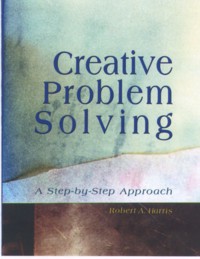
Creative Problem Solving: A Step-by-Step Approach
Robert A. Harris
Los Angeles: Pyrczak Publishing, 2002
ISBN 1-884585-43-4. 106 pp., paper.
This book stresses the practical use of imagination in problem solving. It will help you sharpen the skills you need to solve unstructured problems—problems that require a thoughtful and creative approach. Structured problems such as X + 2 = 4 can be solved by learning the appropriate steps. However, unstructured problems such as how to increase revenue in a struggling bookstore or how to increase the fuel efficiency of a car must first be explored and defined. Then their solutions must be constructed through a combination of imagination and analysis. Most of the activities of our lives boil down to problem solving of one kind or another. This book will help you become a better problem solver in every area of your life.
(A complete table of contents follows the order form.)
Creative Problem Solving
- Defines creative thinking and dispels misconceptions and negative attitudes that prevent creative approaches to thinking and problem solving.
- Helps you understand how to blend creative thinking and critical thinking in solving problems.
- Provides step-by-step guidance for evaluating and implementing creative problem solutions while avoiding the pitfalls of illogical reasoning.
- More than 80 lively examples illustrate how the techniques described in the book can be applied.
- Covers the crucial role of goals and values in finding solutions.
- Discussions of both causation and consequence analysis help keep the problem solving process focused on effective solutions.
- Emphasizes the importance of acceptance in implementing solutions.
- Discusses the management of change as part of solution implementation.
- Stresses the importance of the final step after implementing the solution: evaluation. Did the solution actually work?
- Features dozens of conceptual aids, including diagrams, tables, and Keys of Wisdom.
- Includes end-of-chapter exercises and several appendices to enable you to practice the techniques presented.
Price: $22.95 plus $6.00 shipping. For additional books, add $1.00 each for shipping. Publisher will pay any applicable sales tax.
To order the book, print out the form below and mail it to Pyrczak Publishing, P.O. Box 250430, Glendale, CA 91225.
For faster service, fax the completed order form to 818-246-1277.
Please send me ________ copies of Creative Problem Solving. ISBN 1-884585-43-4.
Name: _______________________________________________
Address: ____________________________________________
City, State, Zip: ___________________________________
Daytime Phone ____________________ Email _____________________
____ Check enclosed for $ __________.
____ Charge my __Visa __MC __AMEX for $_________.
Card Number _____________________________ Expiration (mo./yr.) ____/_____
You can also order by going to www.Pyrczak.com and clicking on Feedback.
Creative Problem Solving Contents
Introduction
Chapter 1 Creative Thinking As a Problem-Solving Tool
1.1 What is creative thinking?
1.2 Why is creative thinking important to problem solving?
1.3 Creative problem-solving methods
Chapter 2 The Creative-Thinking Outlook
2.1 Negative attitudes as blocks to creativity
2.2 Misconceptions as blocks to creativity
2.3 Inflexibility as a block to creativity
2.4 Attitudes that strengthen creativity
2.5 Behaviors that strengthen creativity
Chapter 3 Identifying Problems
3.1 What is a problem?
3.2 Inhibitors to effective problem solving
3.3 Causation
Chapter 4 The Problem-Solving Cycle 1: Exploring the Problem
4.1 Define the problem
4.2 Articulate the assumptions
4.3 Use a 360-degree approach
Chapter 5 The Problem-Solving Cycle 2: Establishing Goals
5.1 The necessity of goals
5.2 The importance of values
5.3 Consider ideal goals
5.4 Establish specific, practical goals
Chapter 6 The Problem-Solving Cycle 3: Generating Ideas
6.1 Associative techniques
6.2 Analytic techniques
6.3 Creative questions
6.4 Brainstorming
6.5 Role playing
Chapter 7 The Problem-Solving Cycle 4: Choosing the Solution
7.1 What is a solution?
7.2 Stop-it solutions
7.3 Mop-it solutions
7.4 Solution paths
7.5 Consequence analysis
7.6 Selection
Chapter 8 The Problem-Solving Cycle 5: Implementing the Solution
8.1 Acceptance and the management of change
8.2 Solution implementation plans
Chapter 9 The Problem-Solving Cycle 6: Evaluating the Solution
9.1 Analyze the implementation
9.2 Determine needed changes
9.3 Review the problem environment
Appendix A Creative Thinking Activities
A.1 Uses for
A.2 Improvements to
A.3 What is it?
A.4 Writing captions
A.5 What iffing
Appendix B Brainstorming Activities
B.1 New names
B.2 Empty the glass
B.3 No counterfeits
Appendix C Problem-Solving Activities
C.1 Analyzing a solution
C.2 A familiar problem
C.3 Many solutions
References
Index